
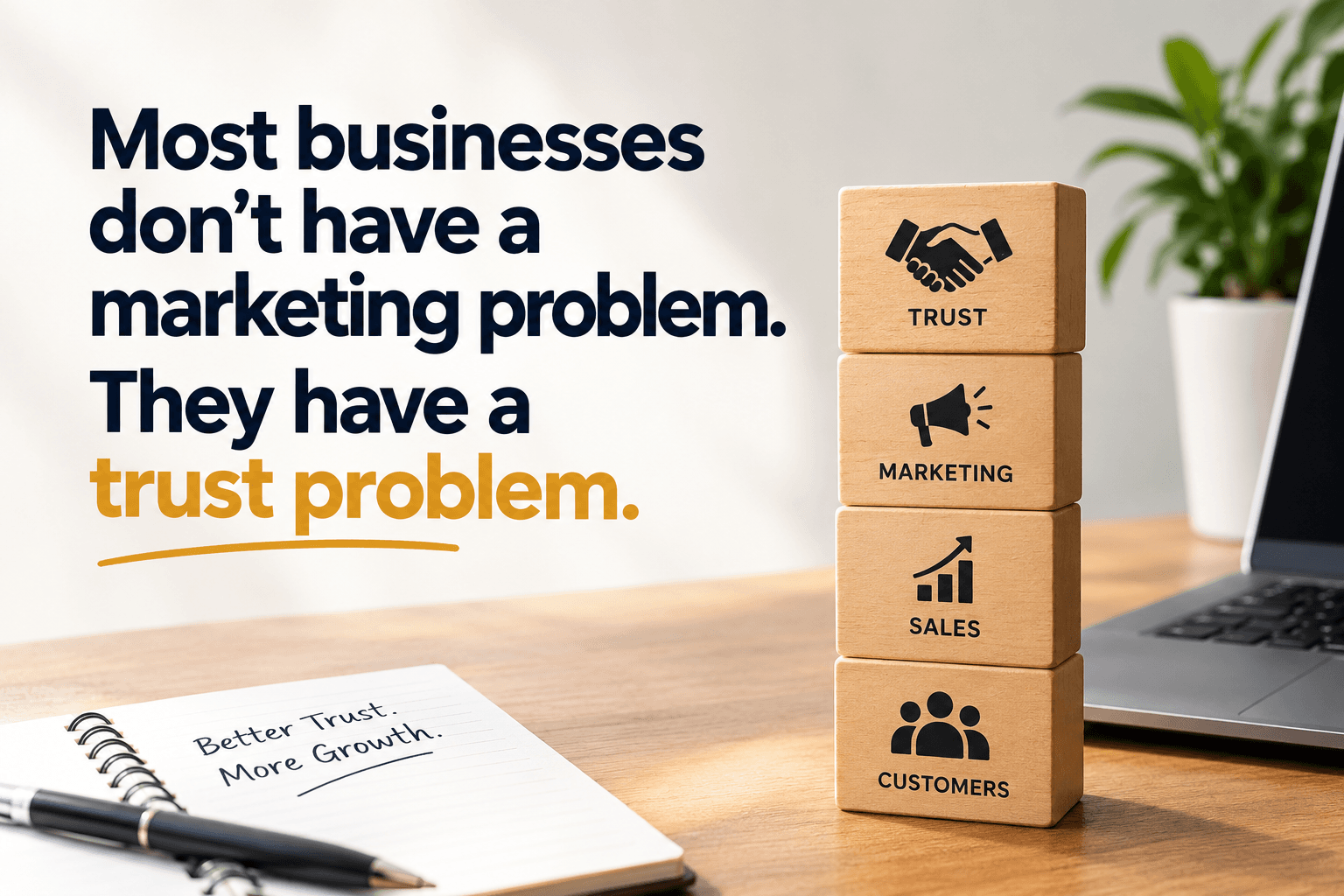

I've reviewed dozens of local business websites this year, and the pattern is almost always the same.
The business is good. The service is solid. The customers are happy, the reviews are real, and the reputation has been built over years.
Then you open the website, and something is off. It doesn't feel wrong, exactly. It just doesn't make you believe.
That gap between the business you actually run and the business your website suggests is quietly costing you customers, and most owners never see it happening.
Ads Bring People In. They Can't Make Them Trust You.
Many business owners treat the website as a box to tick. Get the ads running, send people to the site, and the enquiries will follow.
But an ad has one job: to get a stranger to your page. After that, the ad is finished. It cannot convince that stranger that you're reliable, that your prices are fair, or that you'll actually show up and do the job well.
Only your website can do that, and it has very little time to do it.
A first-time visitor makes up their mind fast. They don't read everything. They scan, they sense, and they decide whether to stay or leave. Trust is built or broken in a handful of specific moments, and each of those moments is a design decision, not an accident.
Let's look at the three that matter most.
Moment 1: The First Headline
The headline is the first thing a visitor reads, and it has to answer three questions almost instantly:
What do you do?
Who is it for?
Why should I choose you?
What breaks trust: "Welcome to our website." "Your satisfaction is our priority." "Quality service you can trust." These phrases could belong to any business in any industry, so they tell the visitor nothing.
What builds trust: A headline that is specific. Compare these two:
"Welcome to Bright Smile Dental Clinic"
"Gentle family dentistry in Port Harcourt, with same-week appointments"
The second one answers the visitor's first question immediately. They know they're in the right place, and that alone lowers their guard.
Try this today: Show your homepage to someone for five seconds, then hide it. Ask them what the business does. If they can't tell you, your headline needs work.
Moment 2: The First Photo
People trust what they can see. The first image on your site tells a visitor whether you're real, whether you're established, and whether you care about the details.
What breaks trust: Generic stock photos. Smiling people in suits shaking hands, a perfect office that doesn't exist, a stranger who has clearly never visited your business. Visitors recognize these instantly, even if they can't explain why, and the feeling they leave with is "this could be anyone."
What builds trust: Real photos. Your actual team. Your actual workspace. Your actual finished work. They don't have to be perfect. A clear, honest photo of a real person doing a real job beats a polished image of nobody in particular.
If you don't have good photos yet, that's an easy and affordable fix. A phone camera, good daylight, and an afternoon of taking pictures of your real work is often enough to start.
Try this today: Look at the main image on your homepage. Could a competitor use the exact same photo? If yes, replace it.
Moment 3: The First Review
This is where many good businesses lose people without knowing it.
You may have wonderful reviews, but if they're buried at the bottom of the page, in a tiny font, or written as vague one-liners like "Great service!", they're doing almost no work for you.
What breaks trust: Reviews that are hidden, generic, or anonymous. A visitor thinks, "Anyone could have written this."
What builds trust: Reviews that are placed early, specific, and attached to a real name. Compare these two:
"Great service, highly recommend."
"They fixed our generator the same afternoon I called, and explained the problem clearly so I wasn't overcharged. — Mrs. Adeyemi, Rumuola"
The second one answers a doubt the visitor didn't even say out loud: "Will they take advantage of me?" That's what a good review does. It calms a worry before it grows.
Try this today: Move your best, most specific review closer to the top of the page, near your main call to action. Ask happy customers for a sentence about what specifically went well.
The Real Goal: Answer Doubts Before They're Spoken
Every visitor arrives with silent questions:
Is this business real?
Can I trust them with my money?
Will they actually do a good job?
What happens if something goes wrong?
If your website doesn't answer these, the visitor will quietly answer them for themselves, and not in your favour. They won't email you to ask. They'll just leave and call the next business on the list.
A website built with trust in mind does more than look better. It answers every doubt before the visitor has to say it out loud. That is the difference between a website that collects visits and one that collects customers.
A Quick Self-Check
Open your website right now and ask yourself honestly:
Can a stranger tell what I do and who I do it for within five seconds?
Are my photos real, or could they belong to any business?
Can a visitor find a specific, believable review without scrolling?
Is it obvious how to contact me, and does it feel safe to do so?
Does the site load quickly and look good on a phone?
If you answered "no" or "not sure" to two or more of these, your website may be holding back a business that deserves better.
One Last Thing
Your business has already earned its reputation. Your website just needs to reflect it.
If you'd like a second pair of eyes on yours, I'm happy to take a look and point out where trust might be leaking. If you need help fixing it, you're welcome to reach out to me at TechSis Consult. No pressure, just a conversation.